
Two computer monitors can share the same screen size, resolution, refresh rate and panel technology yet receive factory quotations that differ by several dollars. For an OEM buyer, the reason is not always visible on the specification sheet. The LCD panel grade, pixel-defect criteria and display assembly structure can all change the cost.
At Yanxun Display, standard monitor quotations are generally based on Grade A panels unless another solution is discussed and agreed with the customer. The supply chain also includes supplier-defined A-, B and other commercial panel bins, as well as panel-maker-supplied LCMs and Open Cell assemblies.
This guide explains how those terms are used in real monitor sourcing. It also shows why a meaningful comparison requires a written quality standard, a traceable panel or module model and a like-for-like bill of materials—not just the words “27-inch IPS monitor.”
Panel Grade and Module Format Are Two Different Decisions
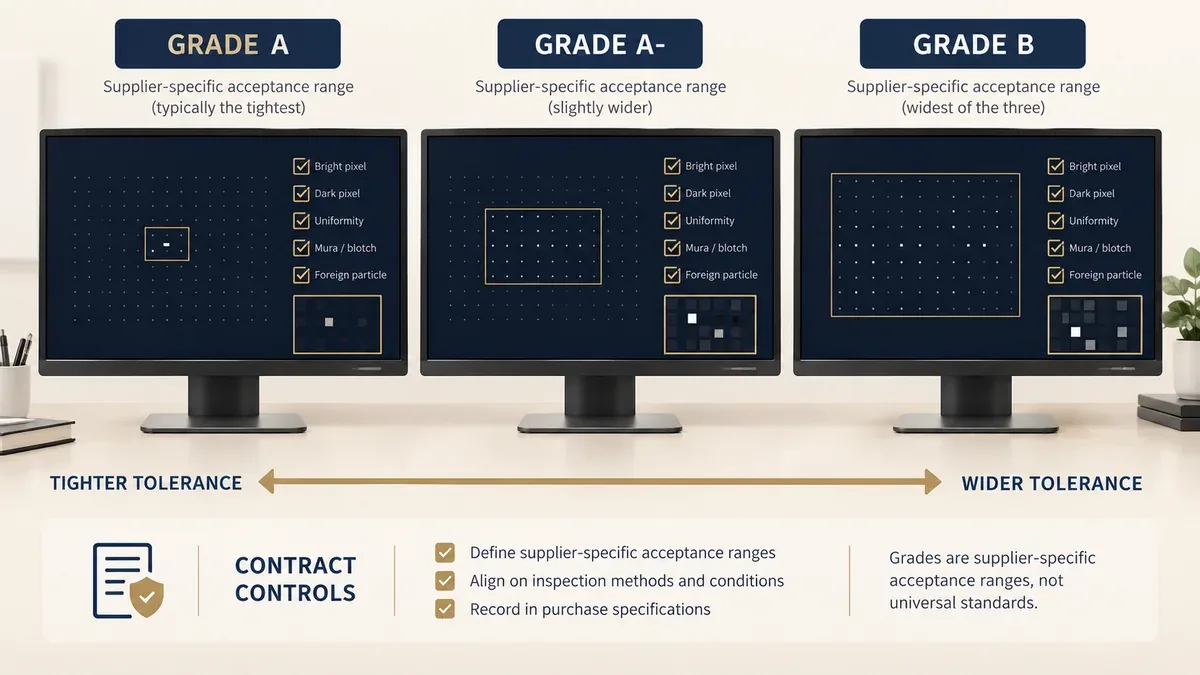
Panel grade and module format answer different questions. Grade A, A- or B describes the visual-defect acceptance applied to a panel lot. LCM versus Open Cell describes how much of the display assembly is supplied as an integrated module.
A Grade A Open Cell and a Grade A panel-maker-supplied LCM can therefore use the same broad display technology while having different BOM structures, downstream assembly responsibilities and quoted costs. Neither term, by itself, determines the quality of the finished monitor.
What Does LCD Panel Grade Mean?
LCD panels are inspected and sorted according to criteria that may include pixel defects, subpixel behavior, surface condition, mura, uniformity, color consistency and other visible anomalies. Suppliers may then use labels such as Grade A, A+, A- or B to describe their commercial bins.
The essential point is that these letters are not universal international classifications. Their definitions can vary among panel makers, distributors, lots and purchasing contracts. A supplier’s Grade A label should not automatically be treated as an ISO pixel-defect class, and A+ should not be assumed to mean ISO Class 0.
For procurement, the useful question is not simply “Is this Grade A?” It is:
What exact pixel, subpixel, surface and uniformity acceptance criteria apply to this quotation?
That question converts a marketing label into a measurable purchasing requirement.
Use Precise Pixel-Defect Terms in the Purchase Specification
“Dead pixel” and “stuck pixel” are familiar consumer terms, but different suppliers may use them differently. An OEM agreement is clearer when it separates full-pixel defects from subpixel defects.
| Term | Practical description | Typical test background |
|---|---|---|
| Bright full pixel | The red, green and blue subpixels remain illuminated together, often appearing white. | Black |
| Dark full pixel | The full pixel does not illuminate normally and appears dark. | White or light colors |
| Bright subpixel | One red, green or blue subpixel remains illuminated. | Black and complementary colors |
| Dark subpixel | One subpixel does not illuminate normally, creating a dark or off-color point. | White, red, green and blue |
The contract should also state how defects are counted, whether clusters are permitted, whether the center viewing area has tighter limits, and what inspection distance, brightness, background and room lighting will be used. A browser-based dead pixel test can help with visual checks, but the production inspection method must still be agreed in writing.
Grade A Panels: What Yanxun Display Normally Quotes
Unless a customer requests another configuration, Yanxun Display generally bases standard OEM monitor quotations on Grade A panels under the applicable supplier specification. This does not mean that every supplier in the market uses the same Grade A definition, or that the word guarantees mathematical perfection under every possible test condition.
During incoming inspection of some specific lots, our team has seen roughly 10% of screens flagged for an isolated colored subpixel point under close solid-color testing. This is a lot-level sourcing and inspection observation—not a universal Grade A definition, an industry-wide defect rate or a product guarantee. Final acceptance follows the written specification agreed for each project.
Our normal Grade A evaluation does not treat a non-functioning full pixel as equivalent to an isolated colored or stuck subpixel. The permitted number, type, position and clustering of any anomaly should nevertheless be confirmed in the quotation or QC appendix.
Why Grade A Does Not Automatically Mean Zero Visible Imperfections
A conventional RGB Full HD panel contains 2,073,600 pixels and 6,220,800 individually controlled subpixels. Manufacturing is highly precise, but commercial display policies still distinguish between defect types, locations and quantities instead of relying only on a broad grade name.
That is why buyers should request measurable acceptance criteria even when every supplier says “Grade A.” The approved sample, inspection standard and mass-production specification should all describe the same product.
Grade A vs A- vs B: A Practical Sourcing Comparison
The table below illustrates common commercial positioning. It is not a universal industry standard, and it must not be used to infer a fixed defect count.
| Supplier label | Common commercial positioning | Relative tolerance | What the buyer must confirm | Cost tendency |
|---|---|---|---|---|
| Grade A | Standard quality projects | Often tighter | All pixel, surface and uniformity limits | Often higher |
| Grade A- | Cost-optimized projects | May be wider | Which additional conditions are accepted | May be lower |
| Grade B | Highly price-sensitive projects | May be wider again | Exact visible-defect limits and warranty handling | May be lower |
Illustrative sourcing pattern only. Grade definitions, acceptance limits and prices vary by supplier, model, lot, order volume and contract.
Why Is Another Monitor Factory Sometimes a Few Dollars Cheaper?
One possible reason is a different panel grade. An A- or B grade panel may still operate normally and may be commercially suitable when the buyer knowingly accepts a wider visual tolerance. Because the sourcing cost can be lower, the finished monitor may also receive a lower quotation.
A lower price does not prove that a lower-grade panel was used. Monitor cost can also change with the backlight, controller board, power supply, housing, stand, interfaces, cables, packaging, QC, warranty, order quantity and payment terms. Panel grade is simply one of the first hidden variables to verify when apparently identical quotations differ unexpectedly.
Lower-cost panel bins are not automatically bad products. They can be appropriate only when the customer’s written specification and end-user acceptance criteria permit them. The problem starts when the buyer believes the comparison is Grade A versus Grade A, while the actual sourcing structure is different or was never disclosed.
When a Cheap Panel Turns Into a One-Time Business
In the monitor export business, we have encountered many cases where buyers were not clearly informed that a quotation was based on a lower-grade, A- or B panel. The buyer found a supplier several dollars cheaper and initially believed the purchase represented an excellent saving.
After mass production and delivery, some buyers later reported more panel-related problems than expected: full-pixel defects, abnormal bright or colored points, yellowish patches, uneven yellow areas, inconsistent screen appearance and other visible anomalies. Their distributors then faced end-customer complaints and after-sales claims.
This is not a universal rule for every lower-grade panel, and B grade does not automatically mean defective. The practical issue is that a less strictly selected panel lot can have wider permitted visual tolerances. If those tolerances are not disclosed, the buyer cannot judge whether the saving matches the risk.
Saving a few dollars at the component stage can become very costly when hundreds of end users later question the display. Replacement units, international and local freight, technician time, retailer complaints and repeated claims can quickly exceed the original saving. For an importer or distributor, the deeper cost is damaged brand confidence and fewer repeat orders.
Yanxun Display does not want to build business by quoting Grade A and then quietly substituting A- or B panels in mass production. If a customer requests a lower-cost grade, the option should be discussed and confirmed before production, with the quality level recorded in the quotation and purchasing agreement.
For us, an undisclosed downgrade might win one shipment, but it can turn a long-term customer into a one-time customer.
Why Credit Sales Make Quality Consistency Even More Important
Some overseas customers purchase from Yanxun Display on credit terms supported by export credit insurance from China Export & Credit Insurance Corporation (Sinosure). That support concerns commercial credit risk; it does not inspect monitors or guarantee product quality.
These arrangements can involve longer payment cycles and repeated orders. In that kind of relationship, reducing the panel grade without disclosure to save a few dollars would create unacceptable commercial and after-sales risk. If one shipment generates extensive end-customer complaints, the consequences continue long after the container arrives.
Stable repeat business is more valuable to us than increasing the margin of one shipment by quietly changing panel quality. We would rather explain why a quotation is several dollars higher than win an order built around a specification the customer does not fully understand.
Before Accepting the Lowest Monitor Quote
If one supplier is several dollars cheaper, ask:
- Is the quotation based on Grade A, A- or B grade panels?
- What exact bright and dark full-pixel criteria apply?
- Are bright, dark, colored or stuck subpixels accepted?
- Are yellow patches, mura and panel-uniformity defects included in the inspection criteria?
- Does the approved sample use exactly the same panel grade as mass production?
- Is the display a panel-maker-supplied LCM or an Open Cell assembly?
- Can the panel or module model be confirmed before production?
- Can the agreed panel-quality standard be written into the purchase specification?
A lower price is useful only when the buyer knows exactly which specification, component or service created the saving.
Panel Grade Is Only Half of the Story
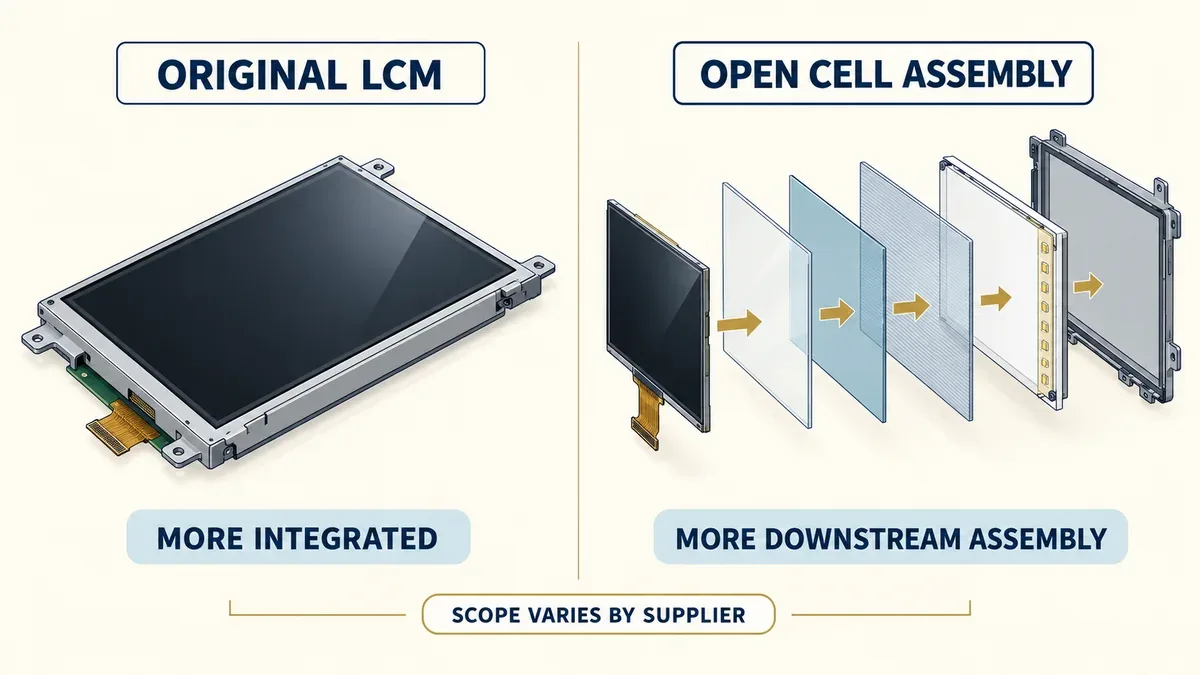
Another major variable is the display assembly structure: LCM versus Open Cell. These terms do not describe a better or worse grade. They describe where the LCD cell, backlight, optical layers and supporting structure are integrated.
This distinction can affect sourcing flexibility, assembly responsibility, quality-control points and cost. It should therefore be confirmed separately from panel grade.
What Is an LCM Panel?
LCM means Liquid Crystal Module. For a desktop TFT-LCD monitor, an LCM generally combines the LCD cell with a backlight and supporting components as a more integrated module. Depending on the manufacturer and model, the supplied module may include the LED light source, light guide plate, optical films, structural frame and driver-related components.
The exact module boundary varies. An LCM is not the entire finished monitor and should not automatically be assumed to include the scaler board, power supply, OSD controls, housing or stand.
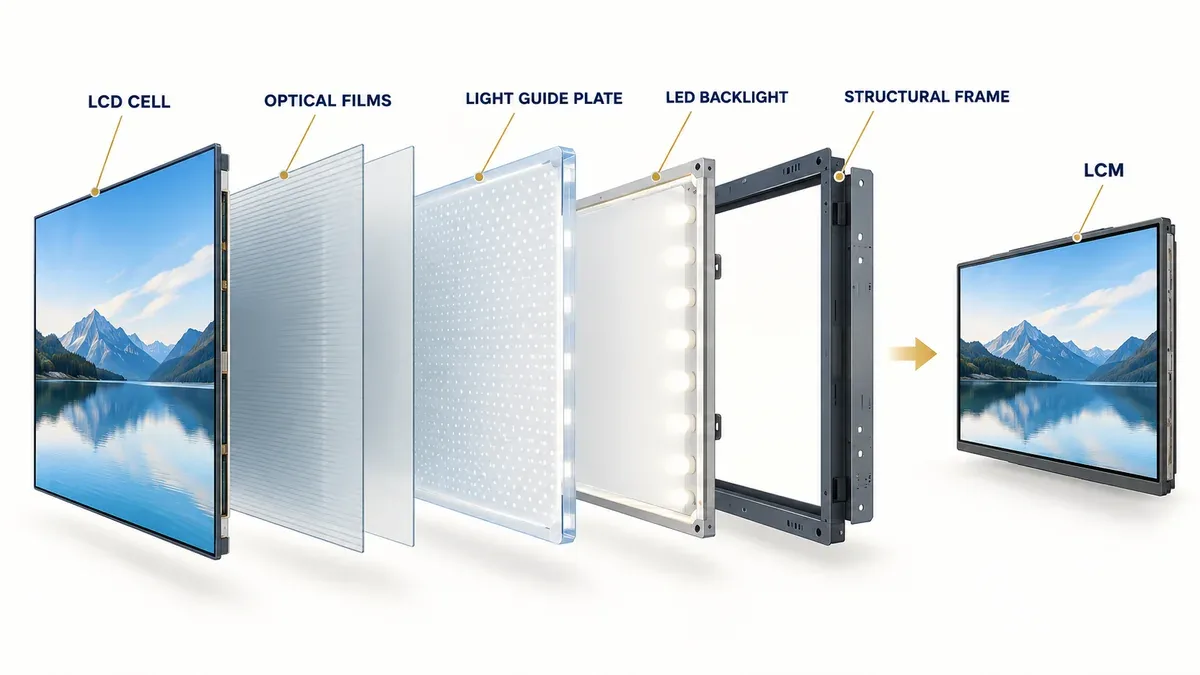
In purchasing language, “original LCM” is best understood as a panel-maker-supplied module identified by its upstream manufacturer, full model number, revision and approved sample—not as an unsupported sales label. Yanxun Display offers products such as this 27-inch original LCM IPS monitor for projects that require this sourcing structure.
What Is an Open Cell Panel?
An Open Cell is the LCD cell supplied without the complete backlight module. It requires downstream integration with a backlight, optical films and structural components before it becomes a usable monitor display assembly.
The exact supplied components still vary by part number. An Open Cell may include polarizers, chip-on-film, flexible circuits or other cell-related elements. Buyers should check the datasheet and BOM instead of assuming every Open Cell has an identical boundary.
Open Cell is an assembly and sourcing method, not a quality grade. A Grade A Open Cell is entirely possible. A well-engineered Open Cell monitor can perform very well when the backlight, films, mechanical alignment, dust control and inspection process are properly managed.
Original LCM vs Open Cell: Practical Differences
| Item | Panel-maker-supplied LCM | Open Cell solution |
|---|---|---|
| Supplied form | More integrated display module | LCD cell for downstream integration |
| Backlight | Normally integrated with the module | Separately sourced or assembler-integrated |
| Optical stack | More upstream integration | More downstream selection and assembly |
| Assembly responsibility | More variables controlled by the upstream module supplier | More variables controlled by the downstream assembler |
| Customization | Usually less flexible at module level | Can offer greater sourcing and design flexibility |
| Cost tendency | May be higher in a like-for-like comparison | May offer lower-cost configurations |
| What to verify | Maker, full module number, revision and approved sample | Cell model, backlight, films, mechanical stack and assembler QC |
These are common sourcing patterns, not guarantees. A higher-spec Open Cell build can cost more than a different LCM solution, and the finished result depends on the complete design and quality controls.
How Panel Grade and Assembly Structure Affect Pricing Together
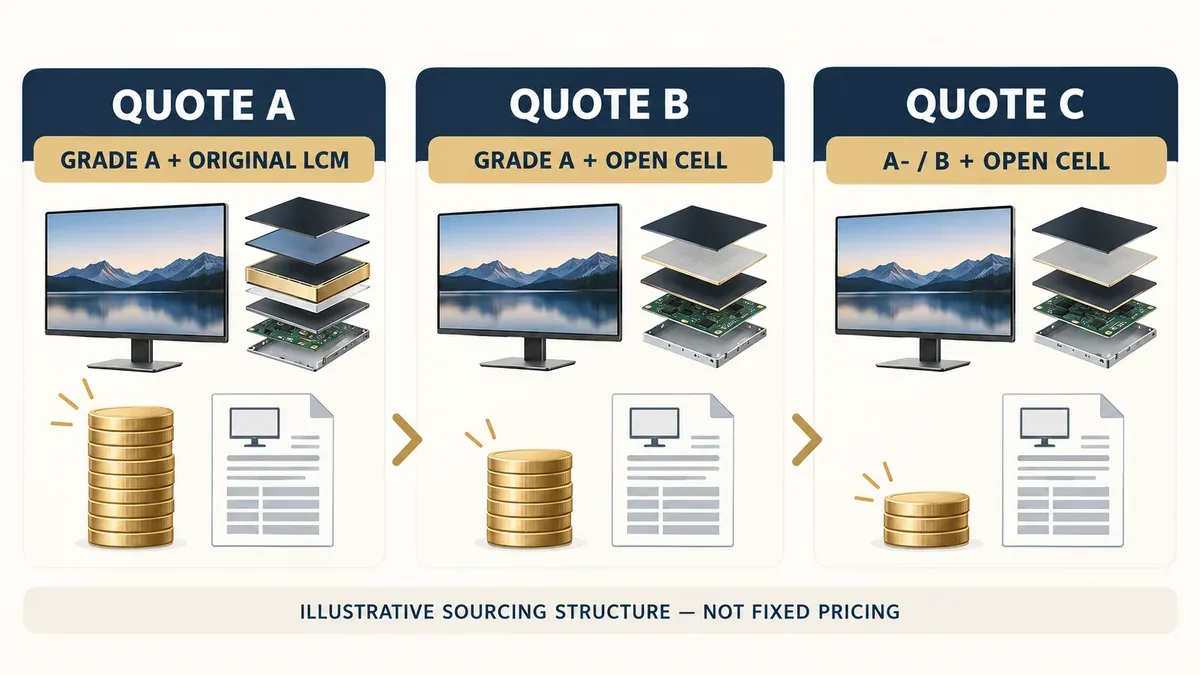
Consider three quotations that all advertise a 27-inch IPS monitor. One uses Grade A with a panel-maker-supplied LCM, another uses Grade A with an Open Cell assembly, and a third uses an A- or B commercial bin with an Open Cell assembly. Their headline specifications can look similar while their sourcing structures and acceptance standards differ materially.
| Example | Panel grade | Assembly structure | QC positioning | Relative cost direction |
|---|---|---|---|---|
| Quote A | Grade A | Panel-maker-supplied LCM | Defined standard QC | May be higher |
| Quote B | Grade A | Open Cell assembly | Defined standard QC | May be lower |
| Quote C | A- or B supplier bin | Open Cell assembly | Wider agreed tolerance | May be lower again |
A difference of four dollars across 5,000 units equals $20,000. That arithmetic example shows why sourcing choices matter at scale; it is not a fixed panel-price difference or a quotation promise.
Panel grade and module architecture can influence a quotation, but neither determines price or finished-monitor quality by itself. A meaningful comparison still requires equivalent controller boards, backlights, power systems, mechanical parts, packaging, QC, warranty and commercial terms.
What Should an OEM Buyer Confirm Before Comparing Prices?
- Panel grade: Which supplier-defined bin is included?
- Pixel limits: What counts apply to bright and dark full pixels and subpixels?
- Location and clustering: Are central-area or cluster limits tighter?
- Visual criteria: How are mura, yellow patches, scratches, particles and uniformity evaluated?
- Inspection method: Which patterns, brightness, viewing distance, room light and sampling plan are used?
- Display structure: Is it a panel-maker-supplied LCM or an Open Cell assembly?
- Traceability: Can the cell or module maker, full model number and revision be confirmed?
- Sample consistency: Will mass production match the approved sample and BOM?
- Change control: Must any substitution receive written buyer approval?
- Remedy: What happens if the production lot fails the agreed standard?
For volume projects, these questions can be worth more than negotiating another dollar from the unit price.
How Yanxun Display Quotes OEM Monitor Projects
Our normal approach is to quote Grade A panels unless the customer specifically requests another commercial grade. Cost-optimized alternatives can be discussed, but they should be identified clearly rather than presented as an identical product.
We also separate panel grade from display structure. A Grade A Open Cell and a Grade A panel-maker-supplied LCM are not the same BOM simply because both are IPS, Full HD and 100 Hz.
Buyers reviewing our office monitors or gaming monitors can discuss pixel criteria, module sourcing, approved panel models and change-control requirements before the sample and mass-production stages.
The goal is not to claim that the most expensive panel is always the right choice. It is to make sure the buyer understands the configuration being purchased and can match it to the end market.
Conclusion: Compare the Panel Behind the Specification Sheet
Two monitors can both be described as 27-inch IPS, Full HD and 100 Hz while using different panel grades, pixel-defect criteria, LCM or Open Cell structures, backlight systems and QC requirements.
Before choosing the lowest quotation, confirm whether the factories are actually quoting the same visual acceptance standard and the same display architecture. Once those details are written into the purchase specification, the price comparison becomes much more meaningful—and the risk of expensive surprises after delivery becomes much lower.
Frequently Asked Questions
What is a Grade A LCD panel?
Grade A is a commercial label commonly used for a panel bin with tighter visual acceptance criteria. It is not a universal international grade. Buyers should verify the supplier specification and write the permitted pixel, subpixel, surface and uniformity conditions into the purchase agreement.
Does Grade A guarantee zero dead pixels?
Not universally. Grade labels vary by supplier, product and contract. A buyer should define bright and dark full-pixel defects and bright and dark subpixel defects separately instead of assuming that “Grade A” guarantees one fixed policy.
Is A+ the same as ISO Class 0?
No automatic equivalence should be assumed. A+ is normally a supplier or seller label, while formal standards use defined terminology and test methods. If a project requires a specific defect class or zero-defect policy, state that requirement explicitly and obtain written confirmation.
What is the difference between LCM and Open Cell?
An LCM is a more integrated display module that generally combines the LCD cell, backlight and supporting components. An Open Cell is supplied without the complete backlight module and requires more downstream optical and mechanical integration. Exact component boundaries vary by model.
Is Open Cell the same as a lower-grade panel?
No. Open Cell describes the display assembly format, while Grade A, A- and B describe supplier-defined commercial bins or acceptance levels. A monitor can use a Grade A Open Cell, and an LCM still needs a defined pixel-defect specification.
Can an Open Cell monitor provide good image quality?
Yes. Open Cell is not a synonym for poor quality. The result depends on the cell specification, backlight, optical films, mechanical alignment, assembly environment and finished-product inspection. A well-controlled Open Cell design can perform very well.
Why can a panel-maker-supplied LCM cost more?
In a like-for-like comparison, an LCM may carry a higher quoted cost because more of the backlight, optical stack and mechanical module is integrated upstream. It is not guaranteed to cost more than every Open Cell configuration, so compare the complete BOM.
Why can two monitor quotations with the same specifications differ?
The headline specification may omit panel grade, pixel policy, assembly structure, backlight components, controller board, power supply, housing, stand, accessories, packaging, QC, warranty and payment terms. A fair comparison requires those variables to be aligned.