
The light guide plate spreads light across an edge-lit LCD monitor. Its material affects light loss, moisture uptake and how well the plate fits as conditions change.
MS, PS and PMMA offer different strengths. Compare the exact grade and complete backlight, not just the material name.
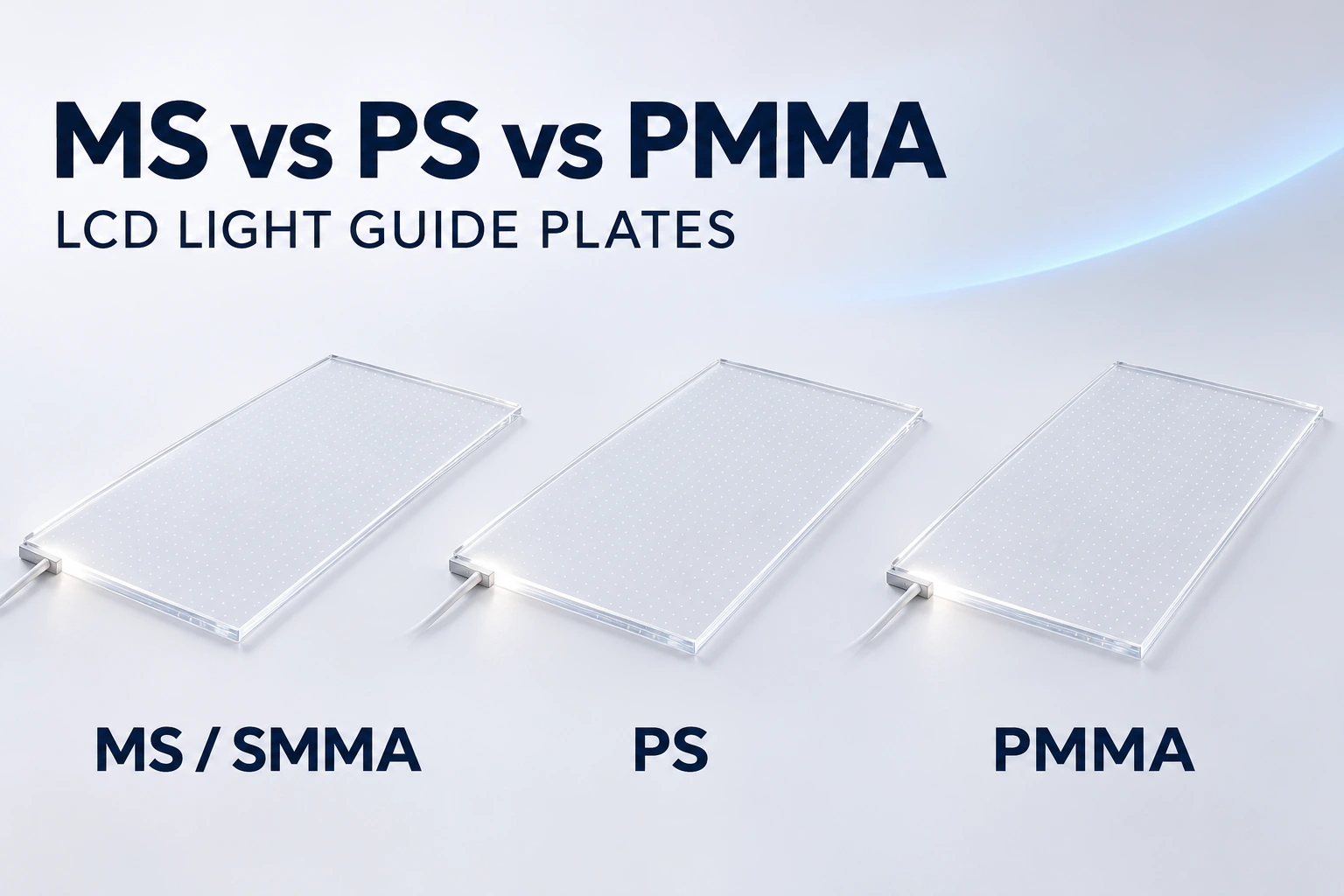
What does a light guide plate do?
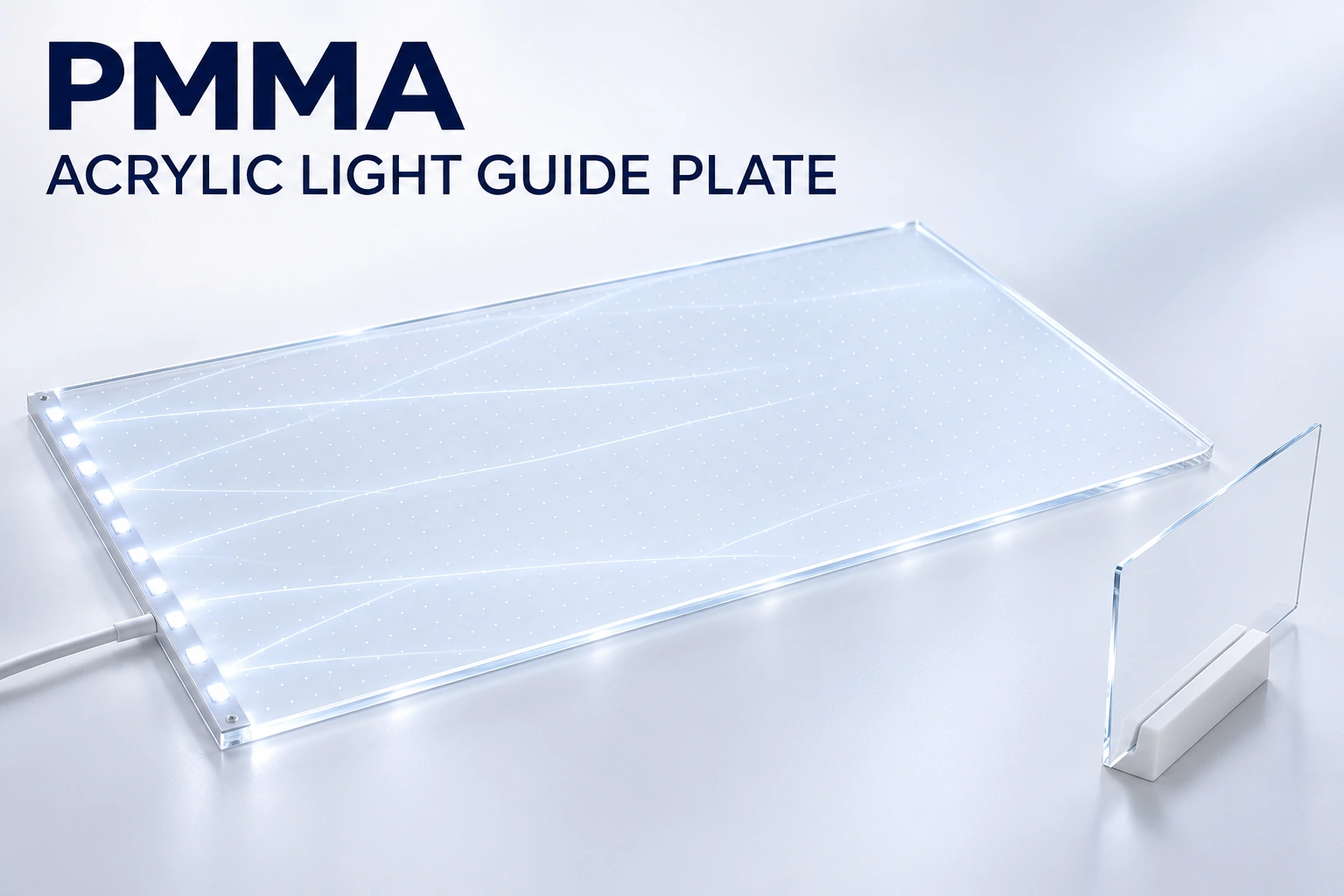
In an edge-lit LCD monitor, LEDs send light into the side of a clear plate. Small patterns on the plate direct that light toward the LCD panel. Reflective and optical films help make the light useful and even across the screen.
The light guide plate is different from a diffuser sheet. It also does not set the monitor's resolution, refresh rate or response time. This comparison applies to backlights that use a light guide plate; OLED displays do not use this type of backlight.
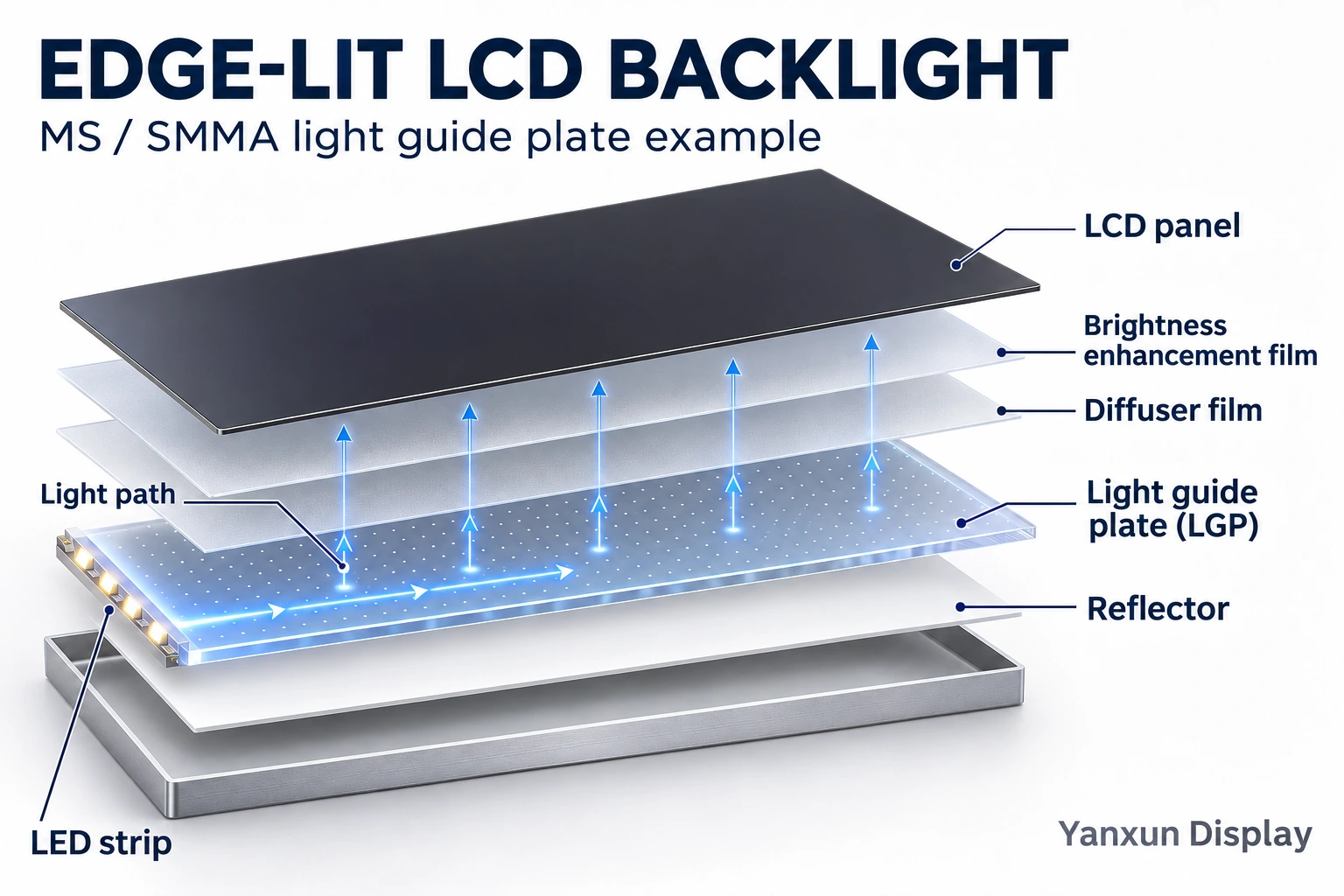
Select the image to view the diagram at full size.
MS, PS and PMMA: the main differences
MS, also called SMMA, is a copolymer made from methyl methacrylate and styrene. PS means polystyrene. PMMA means polymethyl methacrylate, commonly called acrylic. For light guide plates, the grade must be suitable for optical use.
How the three light guide plate materials compare
| What to compare | MS / SMMA | Optical-grade PS | PMMA / Acrylic |
|---|---|---|---|
| Light guiding | Optical grades combine good clarity with lower moisture uptake than ordinary acrylic. | Special optical grades reduce light loss and color tint compared with standard PS. The exact grade matters. | Known for high clarity and low light loss. Well suited to guiding light over longer distances. |
| Moisture and size changes | Generally absorbs less moisture than standard PMMA, helping control size changes. | Low moisture absorption helps limit swelling caused by humidity. | Generally absorbs more moisture than MS or PS. The housing needs room for the plate to expand. |
| Weight at the same size | Common grades are lighter than PMMA. | Usually the lightest of the three. | Usually heavier than MS and PS for the same plate dimensions. |
| Heat and long-term color | Heat resistance and color stability depend on the formulation, not just moisture uptake. | Dedicated optical grades can improve resistance to yellowing compared with standard PS. | Good optical stability is a strength of suitable grades; correct fit remains important. |
| Cost considerations | Compare finished-part quotes; there is no fixed saving over PMMA. | Low density and easy processing can support a lower-cost design. | Weigh its optical benefits against the cost of the specified plate. |
General material trends. Grade, plate thickness, processing and order size affect performance and price.
Moisture and size changes: leave room to expand
A plate that absorbs moisture can grow. If the housing leaves too little room, the plate can press against the frame and bend, causing uneven light known as mura. Lower moisture uptake helps, but every material still needs allowance for heat and moisture expansion.
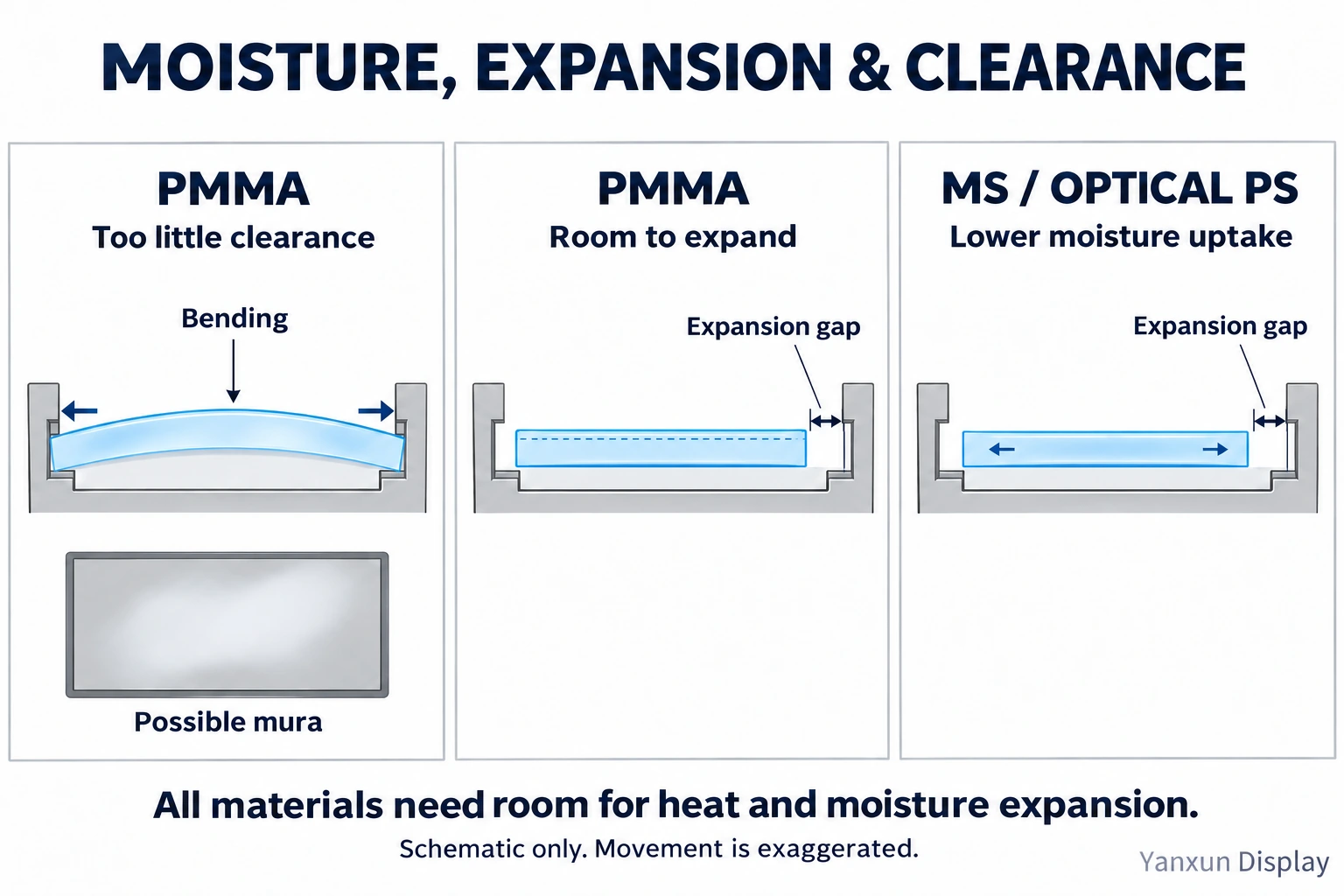
Select the image to view the diagram at full size.
Reference values from named material grades
The examples below use matching test methods from the LG MMA 2017 manufacturer brochure, pages 04–05 and 12–13. They illustrate grade differences; they are not a statement of the materials used in a specific Yanxun model.
Published grade examples, not universal material limits
| Material / grade | Water absorption 24 hours, ASTM D570 | Light transmission 3 mm, ISO 13468-1 |
|---|---|---|
| PMMA HP202 | 0.30% | 92% |
| MS / SMMA HX238 | 0.18% | 91% |
| MS / SMMA HX208 | 0.12% | 91% |
Water absorption is weight gain, not the percentage increase in plate dimensions. For optical PS, request the chosen grade's data under the same conditions rather than assuming one limit applies to all PS.
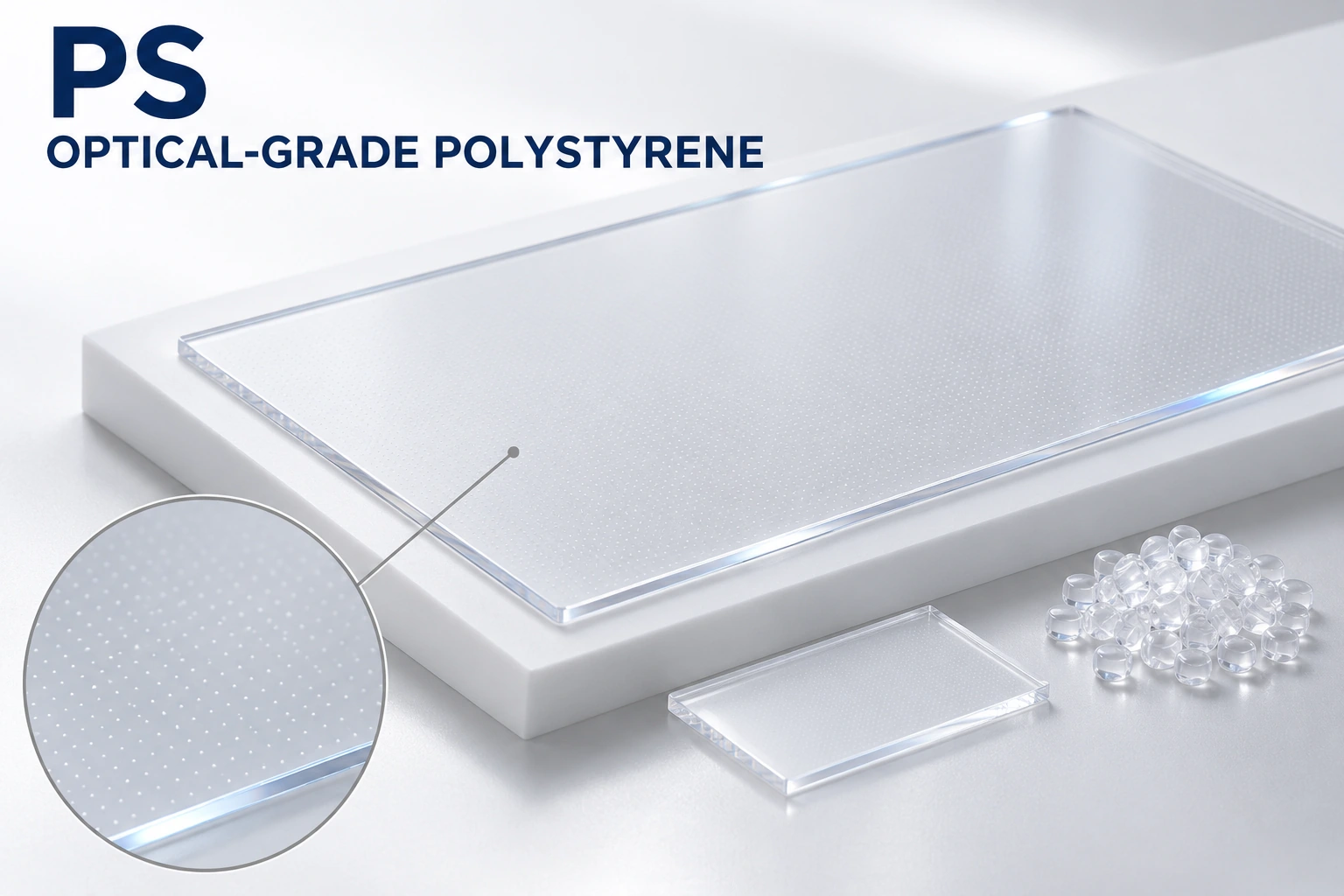
Advantages and drawbacks at a glance
Strengths, limits and reasons to consider each material
| Material | Advantages | Drawbacks and limits | When to consider it |
|---|---|---|---|
| MS / SMMA | Good optical performance with lower moisture uptake than standard acrylic. Useful where space around the plate is tight. | The balance of clarity, heat resistance and moisture uptake changes with the formulation. | Builds that need a balance of light guiding and control of moisture-related expansion. |
| Optical-grade PS | Low weight, low moisture absorption and cost-saving potential. | Standard grades can lose more light or show more tint over a long light path. An optical grade needs its own test data. | Projects with a firm cost target, provided the finished backlight meets the required brightness and uniformity. |
| PMMA / Acrylic | High clarity and strong light-guiding performance, including over longer light paths. | Moisture-related expansion needs space. A tight fit can cause bending and uneven lighting. | Builds where light-guiding performance is a priority and the housing allows for expansion. |
Why a transmission percentage is not enough
Light passing straight through a thin sample travels only a short distance. Inside a monitor's light guide plate, it travels much farther along the plate before reaching the screen. Losses and color changes along that path matter.
The plate's thickness, surface pattern, LEDs, optical films and fit all affect the result. A material with a strong lab figure can still produce an uneven screen if the backlight is poorly designed or assembled.
Longer light paths make optical loss more important. Larger plates and narrow frames also call for closer checks of stiffness and expansion space. There is no reliable screen-size cutoff that makes one resin the right choice for every monitor.
What monitor buyers should check
For office monitors, check white and gray screens for uneven brightness and visible color patches. Compare samples after warm-up, using the same test pattern and matching measured screen brightness.
For LCD gaming monitors, review the backlight alongside the panel and electronics. Changing from PS to MS or PMMA does not, by itself, increase refresh rate, reduce response time or guarantee a wider color gamut.
Before ordering wholesale computer monitors, agree on these points with the supplier:
- Material and grade: record the resin supplier, grade and plate thickness in the agreed build specification.
- Brightness and uniformity: use the same test pattern, settings and measurement points when comparing samples.
- Heat and humidity: agree on test conditions and check for bending, color changes and uneven light afterward.
- Batch consistency: keep an approved sample and require approval before material substitutions.
With a complete LCD module (LCM), the backlight and guide plate may already be fixed by the module supplier. An open-cell build, where the LCD cell is paired with a separately designed backlight, can offer more control over those choices. Confirm the available options before making a material change a purchase requirement.
Common questions
Is MS always better than PS?
No. MS balances clarity and moisture control, while optical PS can offer low weight and cost advantages. Both can be suitable when the backlight meets the required performance.
Does a PS light guide plate always turn yellow quickly?
No. Dedicated optical grades can improve color stability. Heat, processing and operating conditions affect how the material ages.
Does PMMA guarantee a brighter monitor?
No. PMMA's optical properties can help, but screen brightness also depends on the LEDs, plate design, optical films and LCD panel.
Which material should a distributor choose?
Set the price target, brightness requirement and test conditions first. Then choose the grade and backlight design that meet them. Approve the finished monitor, and keep that specification consistent across orders.
Compare backlight options for your next order
Share your screen size, target brightness, budget and order quantity with Yanxun Display. Ask which brightness and uniformity results are available for your proposed configuration, or discuss a sample comparison before placing a bulk order.
See how to customize a monitor and bring your hardware choices, test targets and branding into one approved specification.